Here’s something most small business owners get wrong: they assume hackers are only interested in big targets — banks, hospitals, major corporations. The kind of places that make the news.
That assumption is exactly what attackers are counting on.
If your business is in Dallas, Hiram, Acworth, Villa Rica, or anywhere in Northwest Georgia — and you store customer information, process payments, use email, or rely on computers to run your day-to-day operations — you are a target. Not a maybe target. An active, sought-after target.
The good news is that most attacks can be stopped with the right protections in place. But first, you need to understand why your business is on their radar in the first place.
Cybercriminals are running a numbers game, and small businesses are their favorite numbers.
Here is how they think about it: A major corporation has an entire security team — sometimes dozens of people — watching the network around the clock. Breaking through costs time, money, and risk of getting caught. A small business in Dallas, Georgia? Maybe one person handles IT on the side. Maybe it’s the owner themselves. Maybe nobody is watching at all.
Same payout opportunity. A fraction of the effort.
In 2025, small and mid-sized businesses accounted for over 70% of data breaches — not because they had the most valuable data, but because they had the weakest defenses. Attackers don’t need your business to be worth millions. They just need it to be easier than the next one.
And the numbers get worse. According to cybersecurity research, 80% of small businesses experienced at least one cyberattack in 2025. Of those, nearly 75% said they could not continue operating if they were hit with a ransomware attack.
Read that again: three out of four small businesses hit with ransomware would not survive it.
This is the single most dangerous belief in small business today.
We hear it regularly from business owners across Paulding County and the surrounding area. “We’re just a small shop — why would anyone bother with us?” It feels like common sense. It is not.
Hackers are not sitting in a dark room picking targets by hand. Modern cyberattacks are automated. Bots scan millions of IP addresses every single day looking for open doors — outdated software, weak passwords, unprotected remote access points. Your business does not need to be famous. It just needs to have a vulnerability they can exploit.
Think of it like a car thief walking down a parking lot. They’re not targeting the most expensive car. They’re trying every door handle until one opens.
Your business is one of those cars. The question is whether your door is locked.
Hollywood makes cyberattacks look like someone furiously typing at a keyboard while dodging laser beams. The reality is far more ordinary — and far more frightening.
Most small business attacks start with one of three things:
1. A phishing email An employee gets an email that looks like it’s from Microsoft, their bank, or even their boss. They click a link. They enter their password. Now the attacker has access to everything that account can touch. Employees at small businesses experience 350% more social engineering attacks than those at large enterprises. Attackers know small businesses rarely have security training programs in place, which makes their people the easiest point of entry.
2. An outdated or unpatched system Software updates exist because developers found and fixed security holes. Every day you run outdated software, that hole is wide open. Automated tools scan the internet constantly looking for systems that haven’t been patched — and they find them every second.
3. A weak or reused password “Password1” and “companyname2022” are not passwords. They are open doors. Credential-stuffing attacks — where hackers use massive lists of stolen passwords to try breaking into accounts — are responsible for nearly a quarter of all ransomware incidents.
Once an attacker is in, they move fast. The median time from the moment an attacker gets access to the moment they deploy ransomware is now just 5 days. By the time most small businesses realize something is wrong, it is already too late to stop it without a proper backup and recovery plan.
Ransomware is not just a tech problem. It is a business-survival problem.
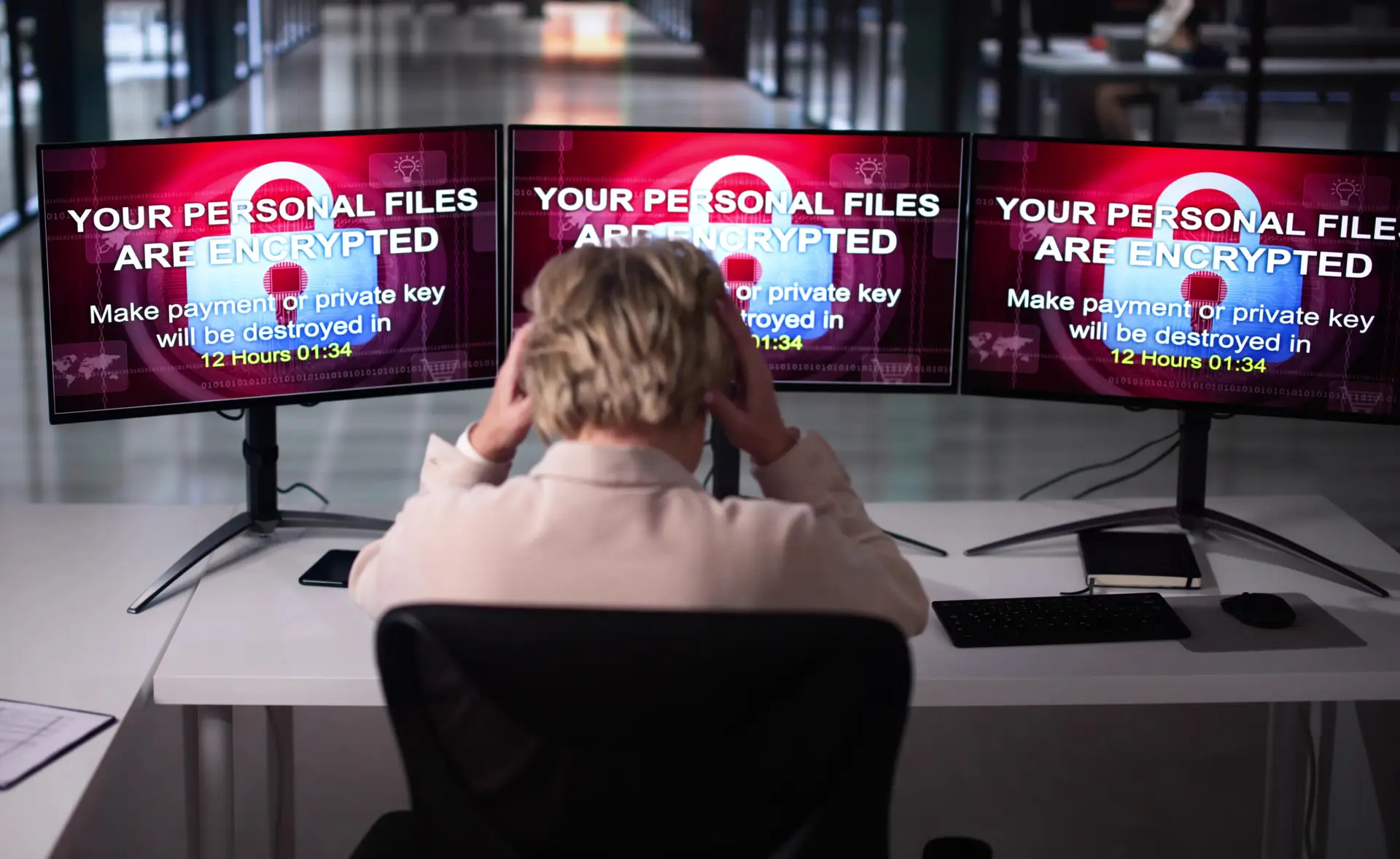
When ransomware hits, every file on your network gets encrypted — scrambled so completely that you cannot open them without a decryption key. Your customer records. Your invoices. Your QuickBooks files. Your employee data. Everything. Locked. Gone.
Then a message appears on your screen. Pay up — sometimes tens of thousands of dollars — or lose it all.
And here is the part most people do not know: modern ransomware groups do not just lock your files. They steal them first. Then they threaten to publish your customer data, your financial records, your private communications online unless you pay. This is called double extortion, and it is now standard practice.
The average cost of a ransomware attack on a small business — including downtime, recovery, legal exposure, and lost business — runs well into six figures. For a small business operating on tight margins in Dallas or Paulding County, that is not a setback. That is a closing.
51% of small businesses that get hit with ransomware pay the ransom. Half of those never fully recover their data anyway.
Here is the part we want you to walk away with: most cyberattacks are not sophisticated. They exploit basic gaps that are completely fixable. You do not need a massive IT budget or an in-house security team. You need the fundamentals done right.
1. Multi-Factor Authentication (MFA) Require a second verification step — a code texted to your phone, for example — to log into email, remote access, and cloud accounts. Even if an attacker steals your password, they cannot get in without that second step. This one measure stops the majority of credential-based attacks.
2. Regular Software Updates and Patching Turn on automatic updates. Make sure your operating system, software, and security tools are current. Most successful attacks exploit vulnerabilities that already have a patch available — the business just never applied it.
3. A Real Backup Plan Not an external hard drive sitting next to your computer. That gets encrypted too. A proper cloud backup that runs automatically, stores data offsite, and gets tested regularly. If ransomware hits, a good backup means the answer to “pay or lose everything” is “neither.”
4. Employee Security Awareness Your team does not need to become cybersecurity experts. They need to know how to spot a suspicious email, why they should never click unexpected links, and who to call when something looks wrong. That awareness is your first and most important line of defense.
5. 24/7 Network Monitoring Attackers do not keep business hours. They probe systems at 2am on a Saturday specifically because no one is watching. Continuous network monitoring catches suspicious activity early — before it becomes a full-scale breach.
Here is the honest truth about cybersecurity for small businesses: you are good at running your business. That is what you do. You should not also have to become a cybersecurity expert on top of everything else.
That is what TechSGA is here for.
We are a locally owned IT company based right here in Dallas, Georgia. When you call us, you reach a real person — not an overseas help desk, not an automated system, not a callback queue. We know Northwest Georgia businesses because we are one. We know what the local threat landscape looks like, what your budget realities are, and how to protect your business without overcomplicating it.
We offer managed cybersecurity services specifically built for small businesses — 24/7 network monitoring, enterprise-grade antivirus protection, firewall management, employee security training, and cloud backup that means ransomware never gets the last word.
If you are not sure whether your business is properly protected — and most small businesses honestly are not — the first step is a conversation. No pressure. No corporate sales pitch. Just a straightforward look at what you have and what, if anything, needs to change.
Your neighbors in Dallas, GA are not going to let you become a statistic.
Most small businesses in Northwest Georgia are more exposed than they realize. Let TechSGA take a look — no call centers, no runaround, no surprise fees.
Call us in Dallas, GA → 770 276-9770
Or click below to get in touch →
